

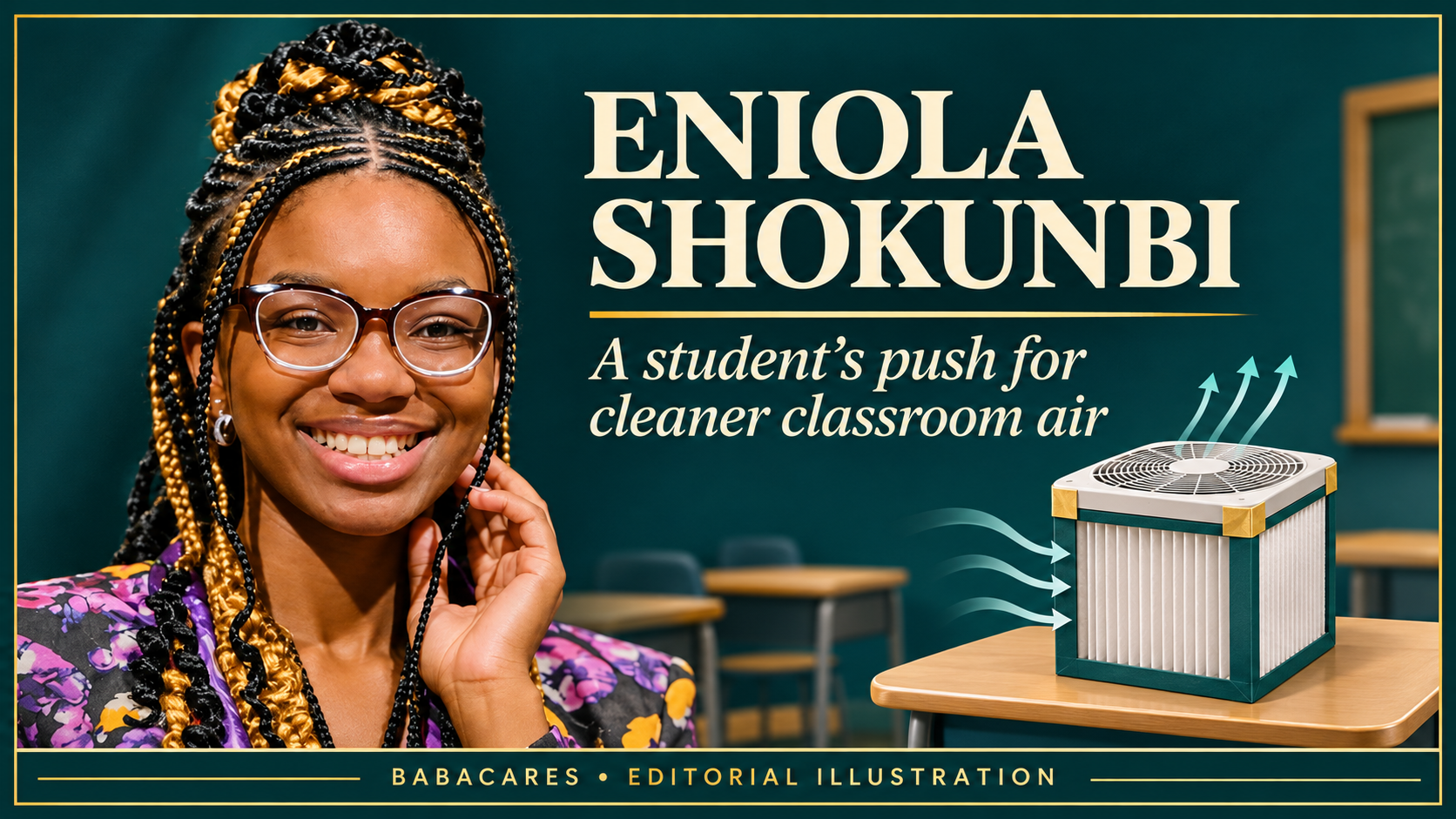
Eniola Shokunbi’s Push for Cleaner Classroom Air: The Real Story Behind the $11.5 Million
By Babajide Moronfolu | Babacares Public Health
When Eniola Shokunbi was in fifth grade in Middletown, Connecticut, she wrote to a University of Connecticut researcher asking for help improving the air in her school. She and her classmates built low-cost air cleaners, and their work reached a U.S. Environmental Protection Agency laboratory for testing. A viral post credits her with inventing a “virus-killing” filter and receiving $11.5 million. Her real achievement was bringing students, scientists and decision-makers into a conversation about the air children breathe at school. UConn Today
Who received the $11.5 million?
Connecticut allocated $11.5 million in October 2024 for a University of Connecticut programme to build and distribute classroom air cleaners. Shokunbi helped champion the effort. The money was public funding for the programme, and the allocation itself does not establish how many classrooms ultimately received units. cga.ct.gov
What does the air cleaner actually do?
The students used an existing design called the Corsi–Rosenthal box. A fan draws indoor air through filters that capture airborne particles, including some particles that can carry respiratory viruses. The box works by filtering particles out of the air. The classroom result can vary with room size, airflow and how the unit is built and used, so a lab result should not be read as a promise that the device will prevent a fixed percentage of infections. UConn Today
What schools can do now
Parents and teachers can start with two questions: How does fresh air get into this classroom, and who checks that the filters are working and replaced on schedule? The U.S. CDC recommends improving ventilation and maintaining existing filtration. Where extra filtration is needed, schools can consider a portable HEPA air cleaner sized for the room. A well-built DIY unit can help as a temporary option when a commercial unit is unavailable. CDC
Eniola started by asking for help with a problem she could see at her own school. Her story gives other students a question worth taking to their teachers and school leaders. What could we do to make the air in our classroom cleaner?
Read more on Babacares.com, subscribe and share.
https://babacares.com/blog-details?details=1231&title=Eniola+Shokunbi%E2%80%99s+Push+for+Cleaner+Classroom+Air%3A+The+Real+Story+Behind+the+%2411.5+Million





Comments